
MANDATORY ARABIC PREPARATORY EDUCATION
About the Faculty of Theology
Established in 2012 by the Council of Ministers’ Decision No. 2012/3527 and accepting students since 2013, our faculty conducts academic research in the field of Islamic sciences, culture, and civilization, sharing these with the scientific community and the public. It possesses a systematic, consistent, and critical perspective. It aims to train qualified and well-equipped theology experts who, by both preserving and developing the values that form our identity, contribute to the peace and continuity of our society and cooperate with public institutions and NGOs in line with these objectives.
The vision of our faculty is to be a pioneering faculty that understands and interprets our religion from its primary sources, establishes its own academic tradition by benefiting from the theological and scientific heritage accumulated over centuries and the achievements of humanity, prioritizes academic integrity and ethical concerns above all else, aims for objectivity while also taking subjective approaches into account, and to be a pioneering faculty that knows the value of these lands and the values they possess.
The name of our faculty, which was established as the “Faculty of Islamic Sciences,” was changed to “Faculty of Theology” by a Presidential Decree published in the Official Gazette on September 15, 2023.
Objectives and Goals of the Arabic Preparatory Program
Our faculty, which focuses on the student in education, aims to provide students with: teach the basic rules of Arabic, provide knowledge and skills related to oral and written comprehension and expression, enable them to follow the courses required by the education and training programs of the Faculty of Theology they are enrolled in, provide them with the skills necessary for language communication in academic and social life, and ensure that they have the ability to follow Arabic publications in various fields. Conducted under the supervision of competent local and foreign teaching staff, the preparatory education, in which the language of instruction is Arabic-Turkish, adopts the principle of teaching Arabic through an interactive method.
Exemption from Preparatory Education
Those who can prove that they have completed their secondary education in secondary education institutions attended by citizens of a country where the foreign language (Arabic) designated as the language of instruction in the Preparatory Class is spoken as a native language, for at least the last three years, Students who have successfully completed the Preparatory Class at another higher education institution with an Arabic Preparatory Class, either abroad or within Turkey, and then transferred horizontally to departments/programs with an Arabic Preparatory Class at the Faculty of Theology, Afyon Kocatepe University; Students who have scored 60 or above in the KPDS/YDS Arabic Exam administered by ÖSYM in the last two years, or who have scored at least 60 in the Proficiency/Exemption Exam, are exempt from preparatory education and may enroll directly in the undergraduate program.
Exams
1. Proficiency/Exemption Exam
Whether students placed in our faculty’s undergraduate program will take preparatory classes is determined by the Proficiency/Exemption Exam administered at the beginning of the academic year. This exam is held twice a year on dates specified in the academic calendar, at the beginning of the fall semester and before spring semester course registration. This exam determines whether the student is exempt from the preparatory class and, if not, at what level they will study in the preparatory class. The passing grade for the Arabic Proficiency Exam is at least 60 out of 100. There is no make-up exam for the Proficiency Exam.
2. Midterms and Finals
The performance of students enrolled in preparatory courses is measured by four midterms/mid-term exams and one end-of-year/final exam. Attendance requirements must be met in order to take the end-of-year/final exam. The passing grade required to successfully complete the preparatory course is 60 out of 100 points. The passing grade is calculated by taking 40% of the midterm/quiz grades and 60% of the final exam grades.
The date of the midterm exams is announced to students at least 10 days before the exam date. The final exam is held on the date specified in the Academic Calendar. Exams may be written only, oral only, or both written and oral. Students who cannot attend any midterm exam for valid and justified reasons must submit their excuses, along with supporting documents, to the Faculty Dean’s Office within 10 working days. Students whose excuses are accepted by the Faculty Board of Administration will be given a make-up exam. No make-up exams are given for final exams.
Condition for Continuing Preparatory Education
Students’ ability to effectively continue and complete their Arabic education depends, first and foremost, on their regular attendance in the courses they take. Therefore, attendance in Arabic Preparatory Class courses is mandatory. Students are required to attend at least 80% of their classes. Preparatory Class students who do not meet the attendance requirement will not be allowed to take the General Exam (End-of-Year/Final Exam) at the end of the year. Since students are required to attend at least 80% of classes, they must use their excuses, such as participating in social and sporting events or being on sick leave, within the 20% absence period. Students who participate in social and sporting events approved by the Rector’s Office are not considered absent for the classes they miss.
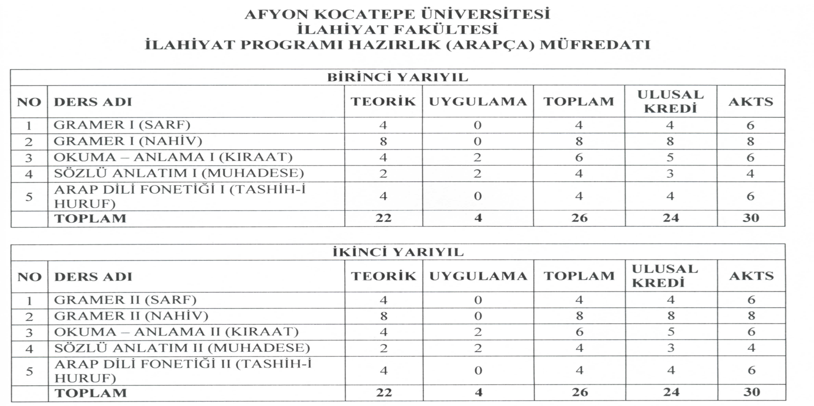
Preparatory Education Curriculum
FIRST SEMESTER (FALL SEMESTER)
GRAMMAR I (SARF): 4 hours per week
GRAMMAR I (NAHW): 8 hours per week
READING COMPREHENSION I (QIRAAT): 6 hours per week
SPOKEN EXPRESSION I (MUHADASA): 4 hours per week
ARABIC PHONETICS I (TASHIH AL-HURUF): 4 hours per week
SECOND SEMESTER (SPRING SEMESTER)
GRAMMAR II (SARF): 4 hours per week
GRAMMAR II (NAHW): 8 hours per week
READING COMPREHENSION II (QIRAAT): 6 hours per week
SPOKEN EXPRESSION II (MUHADASA): 4 hours per week
ARABIC PHONETICS II (TASHIH AL-HURUF): 4 hours per week